
DER Training Modal Addendum: FMCSA
Upon completion of this course, supervisors working in businesses that employ Commercial Drivers License holders and others regulated by the Federal Motor Carrier Safety Administration (FMCSA) will have the skills to take on the role of Designated Employer Representative, with specialized knowledge about the drug and alcohol testing practices and processes required by FMCSA. The individual in this critical position is responsible for ensuring employer compliance with federally mandated drug and alcohol testing regulations and FMCSA-specific requirements. This addendum is an enhancement to the self-guided Designated Employer Representative (DER) training. The course details the protocols and processes required by the Federal Motor Carrier Safety Administration (FMCSA) under 49 CFR Part 382 for businesses that employ Commercial Drivers License holders and others regulated by FMCSA where they differ from or expand on the drug and alcohol testing procedures outlined in 49 CFR Part 40. It is critical for the DER to understand and follow the particular requirements of the transportation mode that regulates their industry. The employer risks non-compliance when following DOT protocols, but not those of their modal agency. DERs working with CDL holders and others regulated by FMCSA must be knowledgeable about the guidelines presented in 49 CFR Part 382 in addition to those covered in 49 CFR Part 40.

DER Training Modal Addendum: FTA
Upon completion of this course, supervisors working in the transit industry, regulated by the Federal Transit Administration, will have the skills to take on the role of Designated Employer Representative, with specialized knowledge about the drug and alcohol testing practices and processes required by the FTA. The individual in this critical position is responsible for ensuring employer compliance with federally mandated drug and alcohol testing regulations and FTA-specific requirements. This addendum is an enhancement to the self-guided Designated Employer Representative (DER) training. The course details the protocols and processes required by the Federal Transit Administration (FTA) under 49 CFR Part 655 for certain employees in the transit industry where they differ from or expand on the drug and alcohol testing procedures outlined in 49 CFR Part 40. It is critical for the DER to understand and follow the particular requirements of the transportation mode that regulates their industry. The employer risks non-compliance when following DOT protocols, but not those of their modal agency. DERs working with transit employees must be knowledgeable about the guidelines presented in 49 CFR Part 655 in addition to those covered in 49 CFR Part 40.

DER Training Modal Addendum: FRA
Upon completion of this course, supervisors working in the railroad industry, regulated by the Federal Railroad Administration, will have the skills to take on the role of Designated Employer Representative, with specialized knowledge about the drug and alcohol testing practices and processes required by the FRA. The individual in this critical position is responsible for ensuring employer compliance with federally mandated drug and alcohol testing regulations and FRA-specific requirements. This addendum is an enhancement to the self-guided Designated Employer Representative (DER) training. The course details the protocols and processes required by the Federal Railroad Administration (FRA) under 49 CFR Part 219 for certain employees in the railroad industry where they differ from or expand on the drug and alcohol testing procedures outlined in 49 CFR Part 40. It is critical for the DER to understand and follow the particular requirements of the transportation mode that regulates their industry. The employer risks non-compliance when following DOT protocols, but not those of their modal agency. DERs working with railroad employees must be knowledgeable about the guidelines presented in 49 CFR Part 219 in addition to those covered in 49 CFR Part 40.

DER Training Modal Addendum: PHMSA
Upon completion of this course, supervisors working for businesses that service pipelines or transport hazardous materials, regulated by the Pipeline and Hazardous Materials Safety Administration, will have the skills to take on the role of Designated Employer Representative, with specialized knowledge about the drug and alcohol testing practices and processes required by PHMSA. The individual in this critical position is responsible for ensuring employer compliance with federally mandated drug and alcohol testing regulations and USCG-specific requirements. This addendum is an enhancement to the self-guided Designated Employer Representative (DER) training. The course details the protocols and processes required by the Pipeline and Hazardous Materials Safety Administration (PHMSA) under 49 CFR Part 199 for certain employees in businesses working on pipelines or in transporting hazardous materials where they differ from or expand on the drug and alcohol testing procedures outlined in 49 CFR Part 40. It is critical for the DER to understand and follow the particular requirements of the transportation mode that regulates their industry. The employer risks non-compliance when following DOT protocols, but not those of their modal agency. DERs working with pipeline and hazardous materials employees must be knowledgeable about the guidelines presented in 49 CFR Part 199, in addition to those covered in 49 CFR Part 40.

DER Training Modal Addendum: USCG
Upon completion of this course, supervisors working in the shipping and maritime industries, regulated by the United States Coast Guard, will have the skills to take on the role of Designated Employer Representative, with specialized knowledge about the drug and alcohol testing practices and processes required by the USCG. The individual in this critical position is responsible for ensuring employer compliance with federally mandated drug and alcohol testing regulations and USCG-specific requirements. This addendum is an enhancement to the self-guided Designated Employer Representative (DER) training. The course details the protocols and processes required by the United States Coast Guard (USCG) under 46 CFR Parts 4, 5, 16 for certain employees in the maritime and shipping industries where they differ from or expand on the drug and alcohol testing procedures outlined in 49 CFR Part 40. It is critical for the DER to understand and follow the particular requirements of the transportation mode that regulates their industry. The employer risks non-compliance when following DOT protocols, but not those of their modal agency. DERs working with maritime and shipping employees must be knowledgeable about the guidelines presented in 46 CFR Parts 4, 5 and 16, in addition to those covered in 49 CFR Part 40.

2026-27 Certified Professional Collector (CPC-U) Exam
2026-27 Certified Professional Collector (CPC-U) Exam
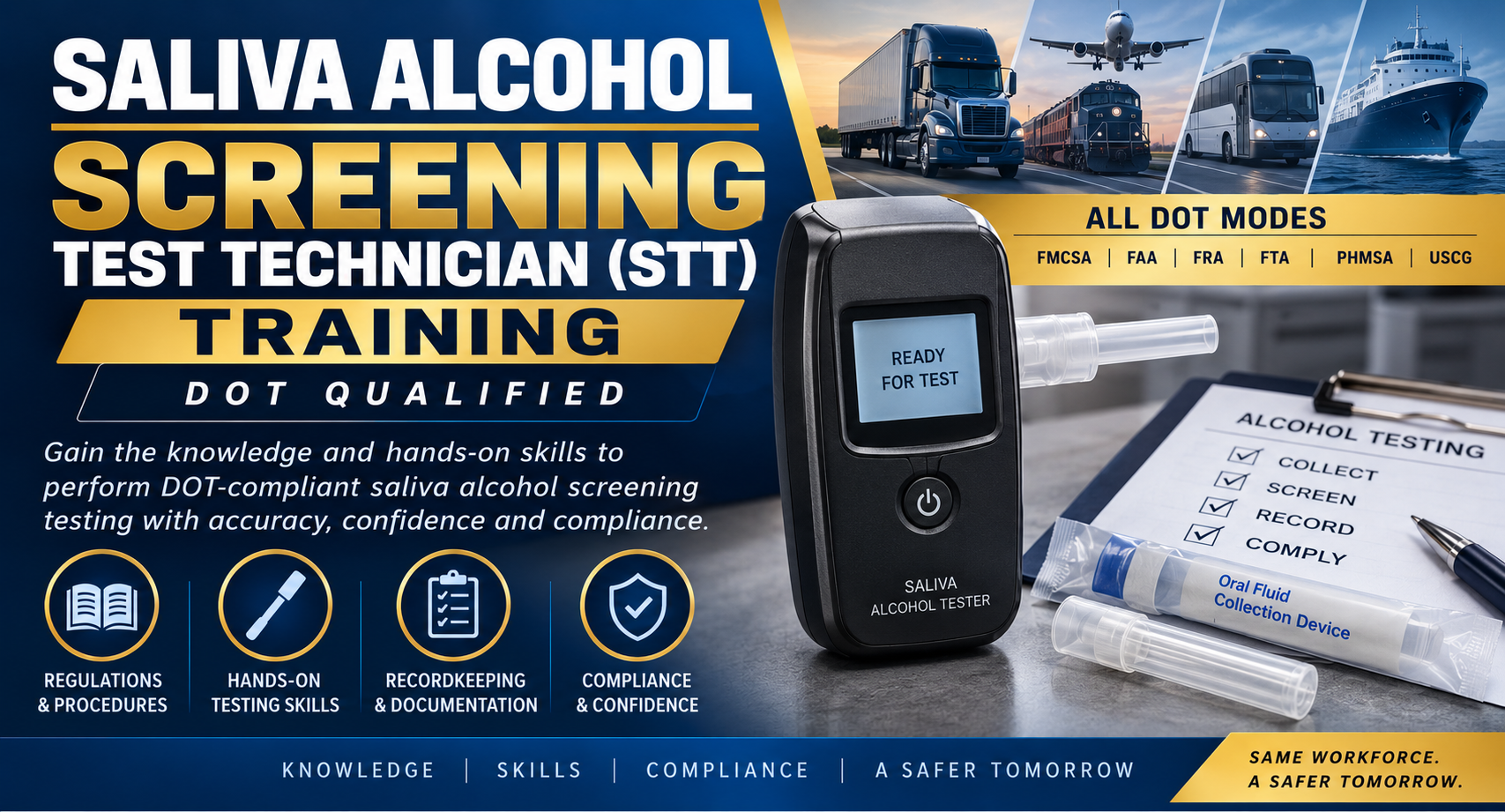
Screening Test Technician (STT) Training: DOT Qualified
The U.S. Department of Transportation Workplace Drug and Alcohol Testing program regulates more than eight million transportation workers in safety-sensitive roles. As part of this effort, the Screening Test Technician (STT) plays a critical role in deterring alcohol use and impairment in the workplace and protecting on-the-job and public safety. Upon completion of this professional-level course, the STT will be qualified to perform alcohol screening in accordance with DOT regulations laid out in 49 CFR Part 40, using best practices and meeting all industry standards for excellence. The STT will also have the knowledge, skills and proficiency needed to successfully perform non-regulated alcohol tests, as DOT sets the gold standard for training related to workplace drug and alcohol testing.
No courses match your search
Try adjusting your search terms or browse all courses.